

Vietnamese cashew nuts face competitive pressure from Africa
Vietnam's cashew industry rose to number 1 in the world thanks to mastering technology. But Vietnamese technology is also helping African cashews compete with Vietnamese cashews.
Occupying the number one position in the world in terms of cashew kernel export volume for nearly two decades, but the historical reversal from trade surplus to trade deficit caused Vietnam's cashew industry to wobble.
From export surplus to import surplus
According to statistics, Vietnam's cashew kernels have been present in 90 countries and territories around the world. Export turnover has increased steadily over the years. In 2006, with a turnover of 520 million USD, Vietnam was officially the world's No. 1 cashew exporter. In 2010, this item helped our country earn 1 billion USD for the first time, and at the same time entered the "billion-dollar club" of the agricultural industry.
After that, from 2.84 billion USD in 2016, cashew exports jumped to 3.36 billion USD in 2018. In the period of 2019-2020, the export turnover of this commodity tends to slow down and decrease slightly. . However, during the past 30 years, Vietnam's cashew industry has always had a surplus.
In 2021, despite being heavily affected by the Covid-19 epidemic, at the end of the year, cashew exports still set a record of 3.64 billion USD, up 12.9% compared to 2020.
However, in the opposite direction, statistics of the General Department of Customs show that Vietnam spent up to 4.185 billion USD to import 2.87 million tons of raw cashew. That is, cashew imports increased by 91.3% in volume and 132.5% in value compared to 2020. This is also the first year that Vietnam recorded a record trade deficit after more than 3 decades of maintaining a trade surplus.
In 2022, the cashew industry regained its trade deficit position when export turnover reached 3.08 billion USD, while imports stopped at nearly 2.68 billion USD.
But, in the first months of this year, this strength of our country returned to the time of trade deficit. Specifically, in the first quarter of 2023, cashew nut exports reached 648 million USD, up 4.5% over the same period last year; while importing nearly $760 million, up 2.8% over the same period in 2022.
Since 2021, the market for raw cashew nuts to Vietnam has also shifted from Africa to Cambodia. Accordingly, in 2021, cashew imports from Cambodia account for nearly 44.8% of the total value of our country's cashew imports; compared to 2020 increased 5.17 times in volume and 6.79 times in value.
In 2022, cashew imports from Cambodia account for 40.6% of the total import value of this item of our country. In addition, it is also imported from Ivory Coast, Ghana, Nigeria, Tanzania,... Fresh unshelled cashews account for 96% of total imports, the rest is shelled fresh cashews.
In the first three months of this year, our country imported cashews mainly from the markets of Cambodia, Tanzania, Ivory Coast, Ghana, and Nigeria. In which, Vietnam spent up to 447.5 million USD to import cashew nuts from Cambodia, accounting for 58.9% of the total value of our country's cashew imports.
Warning for billions of dollars
At the Congress of the Vietnam Cashew Association (Vinacas) for the 2021-2026 term held in Ho Chi Minh City in early 2022, Mr. Pham Van Cong - Chairman of Vinacas, shared the industry's slogan: "When it comes to cashews, think about cashews. to Vietnam".
The biggest advantage of Vietnam's cashew industry is the world's most advanced processing technology, produced by Vietnamese people. Currently, the cashew industry has about 500 enterprises producing and processing, with a capacity of about 4 million tons of raw cashews per year.
However, the policy of African cashew-growing countries (recently Cambodia) is to develop domestic processing industry, gradually reducing raw export. Therefore, they offer many preferential policies to attract investment in cashew processing factories. For export raw cashew nut, they regulate and closely monitor the minimum export price; high export tax rates. On the contrary, they exempt from tax for cashew kernels for export.
In Vietnam, both raw and kernel cashews when imported into the country for processing and export are exempt from tax.
With the above policy, in order to survive, Vietnam's large processing enterprises will switch to imports, narrowing production in the direction of focusing on the last few stages, wasting most of the invested modern lines.
According to Vinacas, for many years, Vietnam has led the global cashew supply chain and value chain, but that position is being shaken and will certainly be lost if we do not change now.
Vinacas is concerned that export cashew processing enterprises, mainly FDI factories, will gradually block the source of raw cashew nuts of Vietnamese factories, causing small and medium-sized factories in our country to go bankrupt. , towards dominating the world cashew kernel market.
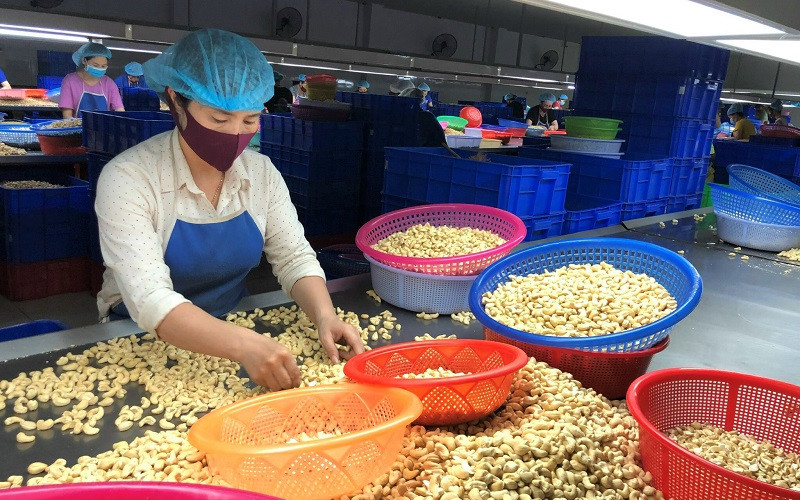
Leading the world in exporting cashew kernels, but Vietnam's cashew industry is too dependent on imported raw materials (Photo: IT)
This is a consequence of allowing the import of cashew kernels into Vietnam without applying measures to protect the domestic cashew processing industry.
Facing the above situation, Vinacas has sent a document "for help" to the Vietnam Federation of Trade and Industry (VCCI) and the Import-Export Department (Ministry of Industry and Trade) on issues related to import tax on cashew; time to impose minimum import prices for cashew kernels imported into Vietnam, as India is doing with imported cashew kernels.
Talk to PV. VietNamNet, agricultural expert Hoang Trong Thuy, said that the price of imported raw cashew nuts is cheaper than domestic products. In recent years, the Vietnamese cashew industry has relied too much on imported raw materials, not focusing on developing the domestic raw material area. Therefore, when countries supplying raw cashew nuts change their production and export strategies, this strong commodity industry of our country is immediately affected.
In fact, cashew acreage in our country tends to decrease steadily. From 440,000 hectares in 2007, to the 2019-20 crop year, the cashew nut area nationwide was only 302,500 hectares, with an output of about 339,800 tons. In 2022, according to the production plan, the total cashew area in the country will remain stable at 305,000 hectares. The average yield is 1.25 tons/ha, the output of raw cashews (dry nuts) is estimated at 370,000 tons.
Worth mentioning, Vietnam is the world's leading cashew exporter, but the increase in raw cashew imports makes it difficult for cashew farmers to sell products, and the purchase price of fresh cashew nuts in the country decreases.
According to Mr. Thuy, Vietnamese cashew businesses need to promote deep processing to gradually increase their proportion in the world cashew industry value chain. Along with that, building a raw material area, because without a stable source of raw materials, the industry is very difficult to develop sustainably.
Source: VietnamNet
